Portfolio vs Resume: Which One Gets You Hired?
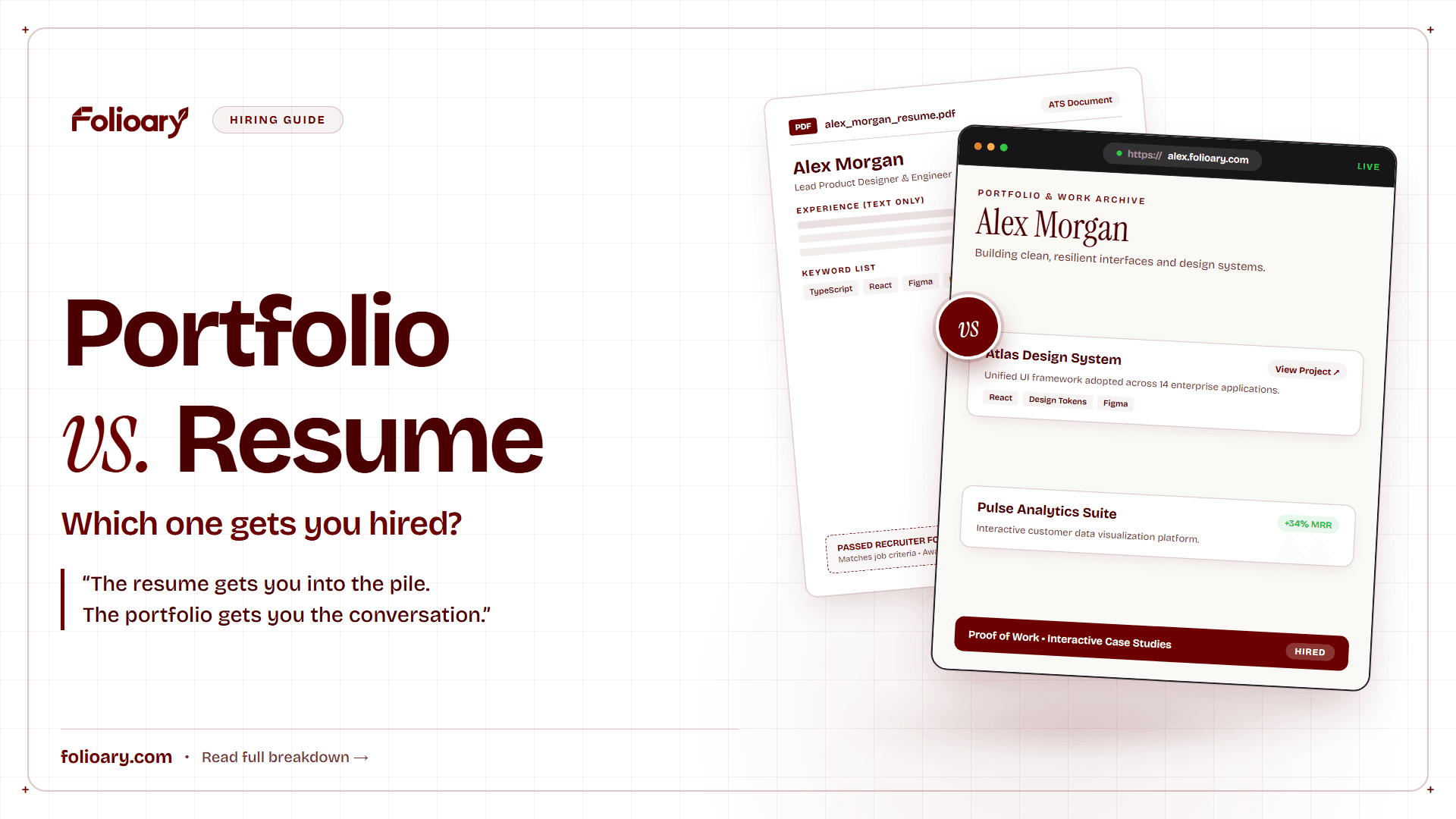
A resume gets you past the form. A portfolio gets you past the doubt. You need both for most jobs. The resume tells a company where you worked and when. The portfolio shows the work, so a person can judge it. Designers should lead with the portfolio. Marketers should lead with results. Developers should lead with projects. Writers should lead with samples. None of these pages can promise a job. They only make it easier for the right person to say yes.
If you only have time for one line, use this: send the resume when a form asks for a file, and put one portfolio link at the top of that file.
The short answer
| Resume | Portfolio | |
|---|---|---|
| What it is | A list of jobs, schools, and skills | Proof of the work you did |
| Usual shape | One or two pages, often a PDF | A website, sometimes a PDF or a set of samples |
| Who reads it first | The application form, then a recruiter | A hiring manager, client, or editor who wants to see the work |
| What it is good at | Dates, titles, and fitting a job post | Taste, skill, and results |
| What it is bad at | Showing how good the work looks or performs | Fitting a form that only accepts a file |
| How often you change it | When a job or skill changes | When you finish a project worth showing |
They are not the same thing. A portfolio does not replace a resume. A resume does not replace a portfolio.
What is a resume?
A resume is a short record of your work history. It usually has your name, a line about what you do, jobs with dates, school, and a skills list. Some people also say CV. In many countries a CV is longer. For this guide, resume means the file you upload when you apply.
A good resume is easy to scan. Each job has a title, a place, dates, and a few lines on what you did. Numbers help when they are true. "Designed the homepage" is weaker than "Designed the homepage. The new page cut support emails about pricing."
A resume is not the place for every project, every poster, or every campaign. Keep it short. Put the real work on the portfolio.
What is a portfolio?
A portfolio is a set of work a stranger can look at without you in the room. It can be a website, a PDF, a folder of files, or a page on a site like Behance. For a job, a website you control is the clearest option. You pick the order. You can update it tonight. You can put one link on your resume, in an email, and on your social profiles.
A portfolio answers three questions:
- What do you do?
- What have you made?
- How do I reach you?
If a visitor cannot answer those three in under a minute, the page is not done.
A resume says you were a designer at a company for two years. A portfolio shows three projects from that time, what the job was, what you made, and what changed after.
Portfolio vs resume: the real difference
People mix them up because both are "about you." They do different jobs.
A resume is read fast, often by a system. Many companies use software to sort applications before a person looks. That software looks for job titles, dates, and words from the job post. A pretty layout can even hurt if the software cannot read the text. Keep the resume simple. Use normal headings like Experience, Skills, and Education.
A portfolio is read by a person who already cares a little. They clicked your link. They want to see if your work fits the role. They will not read your whole life story. They will look at the first screen, open one project, and decide if they keep going.
A resume claims. A portfolio proves. "Brand designer" on a resume is a claim. Three identity projects, with the brief and the final files, are proof. "Grew email revenue" is a claim. A short story with the starting number, what you changed, and the ending number is proof. "Built a React app" is a claim. A live link and the code are proof. "Writer" is a claim. Six pieces a stranger can read are proof.
A portfolio and a resume should match. Same name. Same job title. Same dates, if you mention dates. If the resume says you led the rebrand and the portfolio says you only helped with icons, people notice. Tell the truth about your part.
Which one gets you hired?
Neither one hires you. A person does. The documents only help that person decide.
Here is the usual path:
- You find a role or a client.
- You send a resume because the form asks for one. Some clients skip the form and only want a link.
- A recruiter or founder skims the resume for fit. Title, years, and tools matter here.
- They open your portfolio link if the resume is close enough.
- They look at a few projects. If the work fits, they write back.
So the resume often gets you the look. The portfolio often gets you the reply.
Who weighs more depends on the work:
- Designers: the portfolio does more of the hiring work. A strong resume with weak work still loses.
- Marketers: the portfolio matters when it shows results. A resume full of tool names does not.
- Developers: the resume still opens many doors, but projects and code decide the interview.
- Writers and authors: samples matter more than a list of publications with nothing to read.
If you are early in your career, the portfolio matters even more. You have fewer job titles. The work has to speak.
Designers: send the work first
If you design, people hire what they can see. Logos, interfaces, posters, packaging, and product screens do not fit in a resume line. A hiring manager can read "visual designer, 3 years" in five seconds. They still will not know if your type, color, and layout fit their brand until they see projects.
Use the resume for the application form. Put one link in the header, next to your email. Then put your effort into the portfolio.
What to put on the site:
- A first line that says what you design. "Brand designer for food companies" is clear. "Creative soul who loves pixels" is not.
- A small set of projects, not every file you have ever made. Six strong projects beat forty weak ones.
- For each project: the job, your part, and the result. A picture with no story is hard to judge.
- Big images. Design is visual. Tiny thumbnails hide the work.
- A way to contact you that does not make people hunt.
A PDF is still useful. Some schools and some job forms ask for a file. Make the PDF from the same projects as the site. Do not keep two different stories.
Behance and similar sites can help people discover you. They are not a full replacement for your own page. You do not control the layout, and the page looks like the platform, not like you. Use them if you like. Still keep your own link.
Your first screen should not be a long about essay. Show work, or show one strong project, then the rest. People came to see design.
Designers often get stuck building the site instead of filling it. A layout made for design work starts with an introduction and selected projects, so logos, posts, and product shots each have room. You can browse all the templates and start from a designer layout instead of a blank page. If you are unsure which layout fits, the notes on how to pick a template walk through that choice.
Marketers: show the change, not the job title
Marketing resumes sound the same. "Managed campaigns. Grew social. Worked with stakeholders." A person reading fifty of those cannot tell who is good.
Your portfolio should be two to four short case studies. Each one needs three parts:
- The problem. What was wrong or what the goal was.
- What you did. Your part, not the whole team's, unless you say "we" and explain your piece.
- What changed. A number if you have one. Revenue, signups, cost per lead, traffic, reply rate. If you cannot share the exact number, share a range or a percent and say it is approximate.
Screenshots of ads are not a case study. They are decoration unless you say what happened after the ad ran.
Channels can include SEO, paid ads, email, content, and social. You do not need all of them. Pick the ones you want to be hired for. If you want SEO work, do not lead with a poster you made once.
If you have no client yet, you can still build a portfolio. Do a practice project and label it as practice. Example: "Practice project. I rewrote the homepage of a public site and explained what I would test." Do not pretend a practice project was a paid client. People can tell, and trust drops fast.
The resume still matters. It holds dates, companies, and tools. The portfolio holds the proof those lines point to. Link each strong resume bullet to a case study when you can.
Developers: the resume opens the door, the work keeps it open
Many engineering jobs still start with a resume. The form is required. A recruiter may search for a language, a framework, or a title before they open anything else. So do not skip the resume.
The portfolio, or a clear GitHub profile, is what happens next. A person wants to know if you can build, not only if you have studied.
Put three to five projects on the page. For each one, write:
- What it does, in one sentence.
- Who it is for.
- What you built. If it was a team, say your part.
- The main tools.
- A live link, a demo, or the code. One of these is required. A screenshot alone is thin.
Skip the giant list of every library you have touched. A short stack next to a real project is stronger.
If you are applying for a front-end role, the portfolio site itself is part of the proof. It should load fast, work on a phone, and be easy to read. Heavy animation that makes the text hard to read works against you.
If you are applying for a back-end or data role, do not spend three weeks on visual effects. Spend that time on one project write-up that shows how you solved a problem.
A developer portfolio is not a designer portfolio with different fonts. Design work wants large images. Engineering work wants the stack, the project, and a link to the code. Pick a structure that matches the job you want, not a layout made for posters.
Writers and authors: the words are the portfolio
If you write, people need to read you. A resume can list magazines, clients, or brands. It cannot show your voice, your clarity, or your reporting.
A writer portfolio is simple:
- One line on what you write and who it is for.
- Six to twelve samples. Articles, essays, emails, scripts, or book chapters. Use what you want to be hired to do.
- For each sample: the title, where it ran, the date, and a link or a PDF. Add one line on the result if you have it, such as reads, replies, or what the piece was meant to do.
- A short bio.
- Contact.
A personal blog can be part of the portfolio. It is weaker if you have no published work and the blog is only about your goals. Editors and clients want finished pieces.
Authors with a book should put the book up front: cover, a short description, who it is for, and where to buy or read a sample. Then add essays or articles if you also want that work.
Do not paste your whole resume as the about page. Two short paragraphs are enough. The samples do the rest.
Do you need both?
Yes, for almost every job application.
| Situation | What to send |
|---|---|
| A company form asks for a resume | The resume, with a portfolio link at the top |
| A client says "send work" | The portfolio link first. Attach the resume only if they ask. |
| You are a student or switching careers | Both. The resume shows the path. The portfolio shows you can do the new work. |
| You are freelance and the lead came from a post | The portfolio link. Your resume is optional. |
| A form allows only one file | A simple PDF resume, and put the full URL in the header as plain text |
You do not need two portfolios. You need one clear page, plus a resume file that points to it.
What if you only have a resume?
You can start today. You do not need a new identity, a new logo, or a custom-coded site before you apply.
- Pick three projects from the resume you are proud of. If you are a designer, pick work you can show. If you are a marketer, pick work with a result. If you are a developer, pick work you can link. If you are a writer, pick pieces people can read.
- For each project, write five lines: the problem, your part, what you made, what changed, and a link or image.
- Put your name, one-line offer, those projects, and an email on a single page.
- Add that URL to the top of the resume.
The slow part is usually the blank page, not the words. Folioary can turn the resume you already have into a draft site, then you fix the projects before you publish. The step-by-step guide covers the order: choose a layout, edit the sections, and publish. Read why Folioary was built if you want the short version of the idea: your own site, from work you already did, without learning a website builder first.
After it is live, read it on your phone. If you cannot find the work in ten seconds, move the projects higher.
What if you only have a portfolio?
Keep it. Still make a resume.
Some systems throw out applications with no file, or with a file they cannot read. A link in a cover letter is not always enough. Make a one-page resume with plain text, real dates, and the same portfolio URL. You can build this in a normal document editor. You do not need a design tool for the resume.
If a job post says "portfolio required," do not apply with only a resume. If it says "resume required," do not apply with only a link.
How to send them together
- Put the portfolio URL in the resume header. Use the full link, like
https://yourname.folioary.com, not a button the software cannot read. - Use the same name and the same role title in both places.
- In the email, one sentence is enough: "Resume attached. Work is here: [link]."
- Do not attach ten PDFs. One resume file. One link.
- On the portfolio, make the email or contact form obvious.
- Check the link in a private window before you send it. Broken project links are common.
If you publish on Folioary, the public address looks like yourname.folioary.com. You can build that page from your resume and then replace any line that sounds generic. The draft is a start, not the final story. You still have to add the proof the resume never had: images, numbers, code, or writing samples.
A simple setup for each role
Designer
- Resume: one page, tools, jobs, link at the top.
- Portfolio: six or fewer projects, large images, your role on each.
- First screen: what you design, then the work.
Marketer
- Resume: channels, tools, and three bullets with numbers.
- Portfolio: two to four case studies with problem, action, and result.
- Label practice projects as practice.
Developer
- Resume: title, languages, jobs, link at the top.
- Portfolio: three to five projects with a live link or code.
- Say what you built if the project was a team.
Writer or author
- Resume: short, with publication names and the link.
- Portfolio: six to twelve pieces a person can open.
- Lead with the kind of writing you want more of.
Mistakes that cost interviews
The resume is a slogan list. "Team player. Detail oriented. Passionate." Cut those. Use tasks and results.
The portfolio is an about page with no work. People cannot hire a mood. Show the work.
The designer sends only tiny images. If the work is visual, it has to be big enough to judge.
The marketer shows ads and hides the outcome. Add the number, or say you cannot share it and explain the goal instead.
The developer lists fifteen tutorials. Pick finished projects. A tutorial clone with no users and no explanation is weak.
The writer links to a homepage and hopes people hunt for articles. Link the exact piece.
The two documents disagree. Fix dates, titles, and "I" versus "we" before you apply.
The link is hard to open. Test on a phone. Test with the screen reader if you can. Fancy effects that block the text make you look careless, especially if you build websites for a living.
Questions people ask
What is the difference between a portfolio and a resume?
A resume lists jobs, dates, and skills. A portfolio shows the work from those jobs. You use the resume to apply. You use the portfolio to prove you can do the work.
Are a portfolio and a resume the same?
No. They can talk about the same career, but they are different files with different jobs. Sending one does not cover the other.
Can a portfolio replace a resume?
Only when the other person says a link is enough. If the application asks for a resume, send a resume. Put the portfolio link on it.
Do designers need a resume if the portfolio is strong?
Yes, if you are applying through a company form. The portfolio does more to show your skill. The resume still gets the form submitted and gives dates and context.
What are good portfolio vs resume examples?
A designer resume says "Rebranded a bakery chain, 2024." The portfolio shows the logo, the menu, the pack, your role, and where it shipped. A marketer resume says "Cut cost per lead by 18%." The portfolio explains the old ads, the change, and the new number. A developer resume says "Built the billing page." The portfolio links the page and says what you owned. A writer resume says "Essay in [publication]." The portfolio links the essay.
How many projects should be in a portfolio?
Enough to prove the kind of work you want. For most people that is three to six projects. Writers can use more samples because each one is short to open. Do not add weak work just to look busy.
What if my best work is under a non-disclosure agreement?
Share what you are allowed to share. You can describe the problem, your role, and the result without naming the client or showing private screens. A small public or practice project is fair to include if you label it honestly.
What to do today
- Write one sentence: who you help and what you make.
- Choose three pieces of proof from your resume.
- Put the sentence, the proof, and your email on one page.
- Paste that link into the top of your resume.
- Apply with both.
Do the designer version first if you design, even if you also write or code. The work has to be visible. Marketers should add numbers next. Developers should add links. Writers should add samples.
That is the whole difference. The resume gets you into the stack. The portfolio gives a person a reason to take you out of it.

Written by Muhammad
Founder of Folioary. Full-Stack Web & Applied AI Developer passionate about building modern, scalable web applications and intelligent systems.